
Venture capital in biotech has a secret: investors bet on teams, not just molecules. Here’s what the evidence says about who actually gets funded – and why multidisciplinary expertise is now the single biggest structural advantage a small biotech can have.
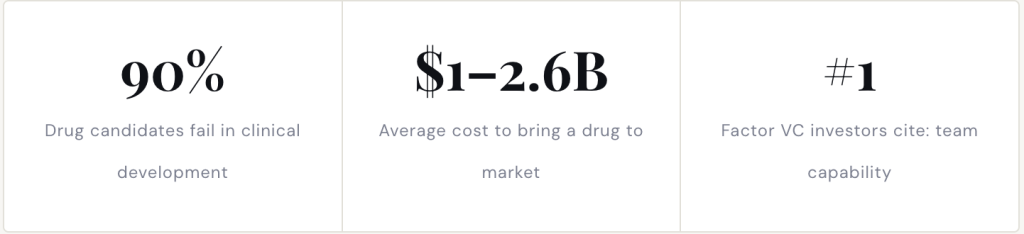
Approximately 90% of drug candidates that enter clinical trials never make it to market. Science is not the only culprit. Not always, anyway. But often because the team couldn’t navigate what came next – the regulatory maze, the investor scrutiny, the pivots nobody planned for.
And yet most early-stage biotech founders are still pitching like it’s 1995 – leading with the molecule, the mechanism, the IP. Science first, team later. That calculus is backwards.
What Investors Actually Fund
Ask any life science investor what they evaluate first, and you’ll hear the same answer with surprising consistency: the team. Not the target. Not the platform. The people, and their collective ability to execute.
This isn’t sentiment – it’s rational risk management. At the seed and Series A stages, most biotech companies have preclinical data at best. The scientific asset is still theoretical. What’s real, and what investors can actually evaluate, is the team standing in front of them.
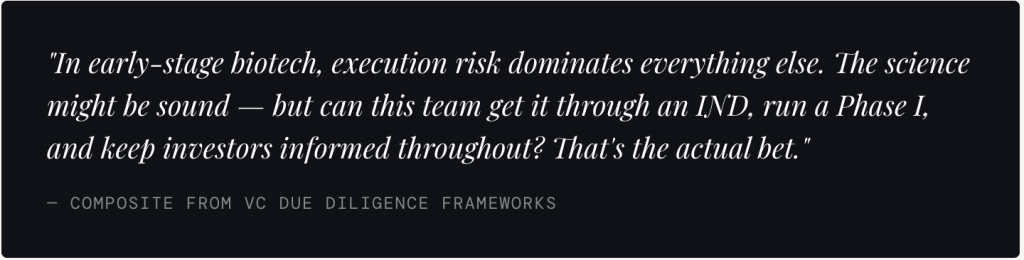
A comprehensive analysis of over 1,200 high-tech ventures, 426 of them in life sciences, found that team human capital and social capital were significant predictors of venture outcomes, with the effect especially pronounced in biotech due to sector complexity. The mechanism isn’t mysterious: investors use team composition as a proxy for risk distribution.
The Multidisciplinary Problem
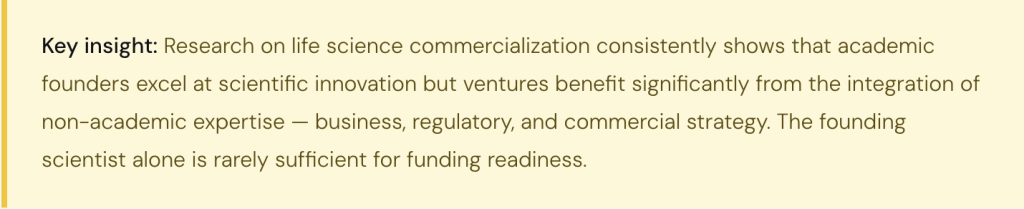
Biotech is unusual among innovation sectors in that it demands simultaneous competence across domains that rarely overlap in a single person or small founding team.
- Scientific discovery
- Clinical development
- Regulatory strategy
- Business & finance
- Commercial access
- IP strategy
Moving a compound from discovery to clinic to market isn’t a relay race where you hand off expertise at each phase. These domains interact constantly. A regulatory misstep in trial design isn’t just a regulatory problem — it’s a data problem, a cost problem, and eventually an investor confidence problem.
Software startups can iterate cheaply. Biotech can’t. A flawed trial design can consume $10M and two years before anyone realizes the endpoint won’t satisfy the FDA.
Multidisciplinary teams aren’t a luxury — they’re a risk-mitigation infrastructure.
Three Mechanisms That Matter to Investors
01 — RISK DISTRIBUTION
Investors evaluate multiple risk stacks simultaneously: scientific feasibility, clinical viability, regulatory pathway, commercial potential. A team with coverage across these domains doesn’t eliminate risk, it distributes it, and demonstrates that the company has thought through each layer. A team of brilliant scientists with no regulatory or clinical expertise signals that the hardest problems haven’t been anticipated yet.
02 — EXECUTION CREDIBILITY
Milestone achievement, IND filing, Phase I completion, partnership deal, is what drives biotech valuation. A multidisciplinary team signals not just that the science is interesting, but that the company has the operational architecture to actually reach those milestones. This credibility is often the difference between a term sheet and a pass.
03 — CAPITAL EFFICIENCY
Poor trial design, regulatory rework, avoidable CRO misalignment, these failures are expensive and common. Teams with integrated expertise avoid them more often. For an investor deploying capital into a sector where failure is the statistical norm, a team that shortens iteration cycles and avoids preventable setbacks is categorically more attractive.
The External Expertise Workaround
Here’s where it gets practically important for early-stage companies that can’t afford a C-suite of specialists on day one: the evidence doesn’t require that expertise be internal.
Biotech ventures routinely rely on CROs, regulatory consultants, clinical specialists, and scientific advisors to fill capability gaps. The research supports this as a legitimate structural substitute, what matters to investors and to outcomes is that the expertise is accessible, not necessarily on the org chart.
This has a direct implication: access to a curated, multidisciplinary expert network is a fundable asset. Not just operationally useful — fundable. Companies that can demonstrate structured access to regulatory, clinical, and commercial expertise are presenting a more credible risk profile than those with a strong scientific team operating in isolation.
What the Evidence Supports
FINDING 01
Multidisciplinary team composition is consistently associated with stronger venture outcomes in life sciences, the effect is more pronounced here than in any other tech sector studied.
FINDING 02
Investors at early stages treat team capability as the primary proxy for execution. In the absence of full clinical data, it’s the most legible signal available.
FINDING 03
Single-discipline teams are structurally insufficient at scale, not because scientists aren’t brilliant, but because the development pathway demands more domains than any one background covers.
FINDING 04
Access to external multidisciplinary expertise functions as a strategic substitute for internal team breadth, and is increasingly recognized as such by sophisticated investors.
The Honest Caveats
No major public dataset directly maps team functional composition to funding outcomes at scale, that granular data doesn’t yet exist in cleaned, systematic form. There’s also real selection bias at play: strong teams attract strong investors, and strong investors attract stronger teams. Causality runs in multiple directions.
And yes, some homogeneous founding teams succeed, especially when founders carry unusually broad experience. The argument isn’t that multidisciplinary teams always win. It’s that in a sector with 90% clinical failure rates and billion-dollar development costs, investors are rational to weight team composition heavily, and founders should structure accordingly.

The companies that get funded aren’t always the ones with the best science. They’re the ones that have made the path to clinic look navigable, and that navigability is almost entirely a function of who, and what expertise, is in the room.
Join a curated network that connects specialized consultants with early-stage companies at the moments that matter most.
Join Connect Research →
3 Responses
This is such an important point, especially for early-stage biotech teams. Great science is the foundation, but it is rarely enough on its own. Investors need to believe that the team can navigate the full path: regulatory, clinical, commercial, operational, and financial.
What stood out to me most is the idea that multidisciplinary expertise does not always need to sit internally from day one. For many small biotechs, structured access to the right external experts can be the difference between moving forward with confidence and losing time, money, or investor trust.
The science matters. But the ability to execute is what makes the science investable
What I like about this is that it reframes “team” as more than a list of impressive titles.
In biotech, the real question is not only who discovered the science? It is also: who can pressure-test the development plan, anticipate regulatory gaps, challenge the trial design, think through market access, and help the company avoid expensive wrong turns?
wish you all the best