
If you’ve been applying for life sciences roles and hearing nothing back, the problem may not be your resume. Some of the jobs you applied to were never going to be filled.
Two forces are shaping the 2026 search, and they’re connected: the market is genuinely crowded, and a real share of the openings you see online aren’t real. Once you can tell the difference, you stop burning energy on listings that were going nowhere and put it where it counts. Here’s what the data shows, how to spot a ghost job, and how to run a search that gives you a real shot at an offer.
The market is tight, but it isn’t frozen
The past two years were rough. By BioSpace’s tally, roughly 42,700 biopharma employees were hit by announced or projected layoffs in 2025, a 47% jump over the year before. The summer was the worst of it: from May through July, 68 companies cut or projected cutting about 15,200 staff. Federal reductions at HHS hit thousands of FDA and NIH workers on top of that.
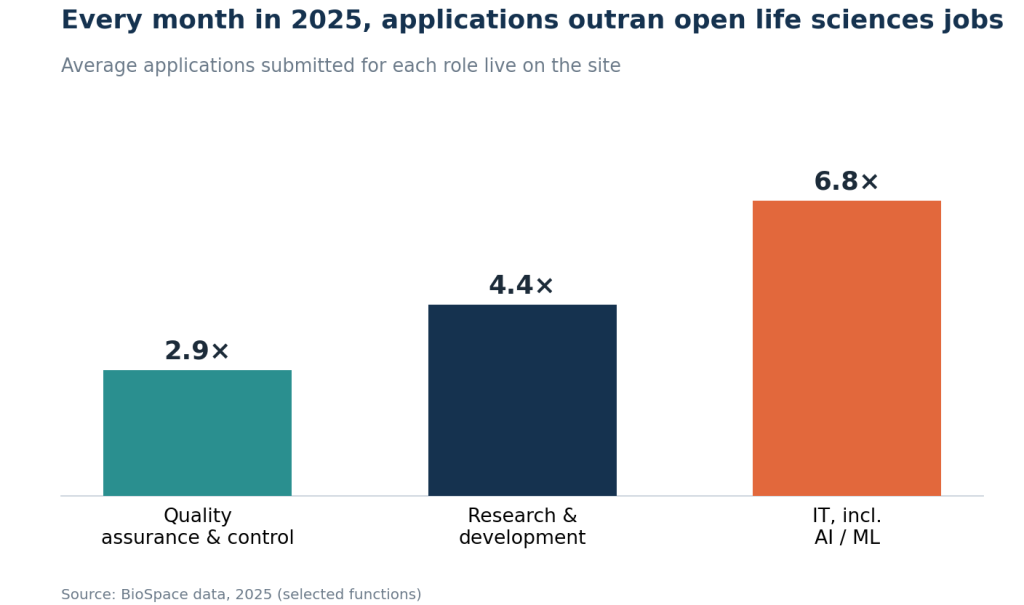
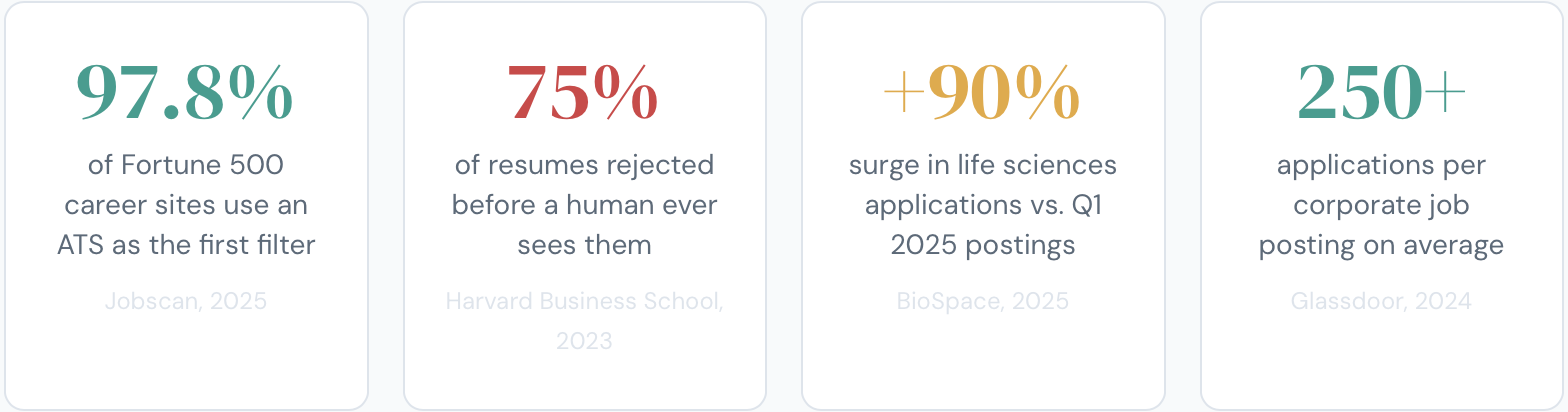
The result is a lot of qualified people chasing fewer seats. BioSpace’s 2026 U.S. Life Sciences Employment Outlook, built on a late-2025 survey of nearly 1,500 professionals, found 52% of those already employed were actively job-hunting, up from 46% a year earlier; among the unemployed, 93% were looking. And every month of 2025, applications submitted on BioSpace outran the jobs actually live on the site.
That crowding is real, and so is the frustration behind it: 85% of unemployed respondents said they were considering leaving biopharma altogether. But that isn’t the whole picture. In the first quarter of 2026, the pace of layoffs slowed year over year, and recruiters at industry briefings were noticeably more upbeat, describing real conversations about real openings and predicting the market would tilt back toward candidates by mid-year. There’s also a quieter dynamic: many experienced people left the industry during the downturn, so the bench is thinner than it was in 2023. Supply has shrunk even as demand starts to recover, which favors the people who stayed in the field and stayed visible.
Why so many openings aren’t real
A ghost job is a live posting for a role the employer has no real intention of filling right now. The company exists. The listing looks legitimate. But no one is getting hired, and often no one was ever going to be. The Congressional Research Service defined these in an April 2025 report as postings for positions that don’t exist or that employers aren’t planning to fill.
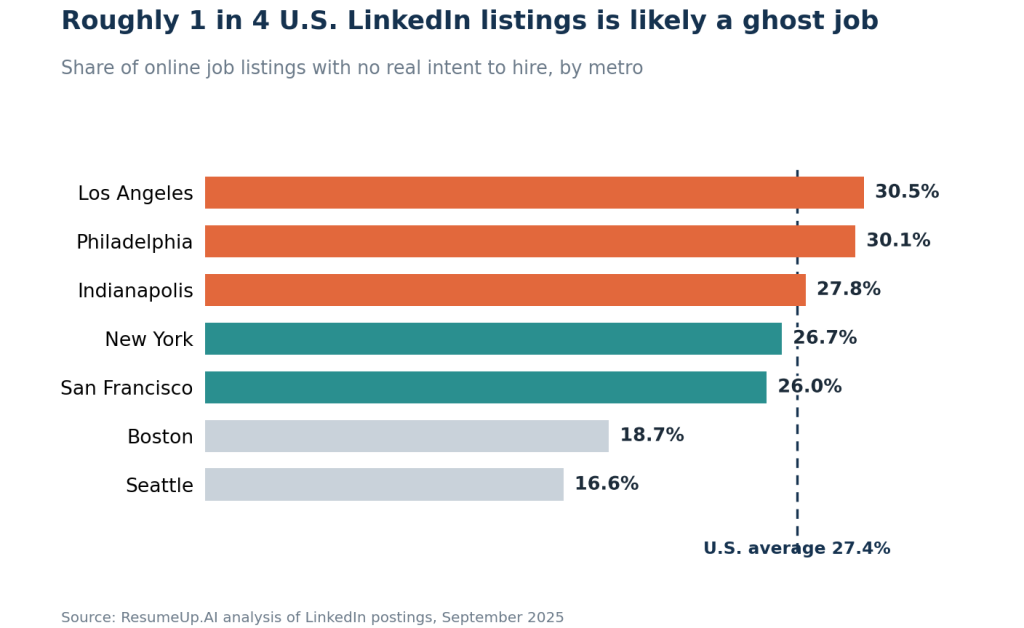
The scale is the surprising part. Estimates from 2024 and 2025 put 18% to 27% of online listings in this category. A September 2025 analysis by ResumeUp.AI found 27.4% of U.S. LinkedIn listings were likely ghost jobs, above 30% in some metros.
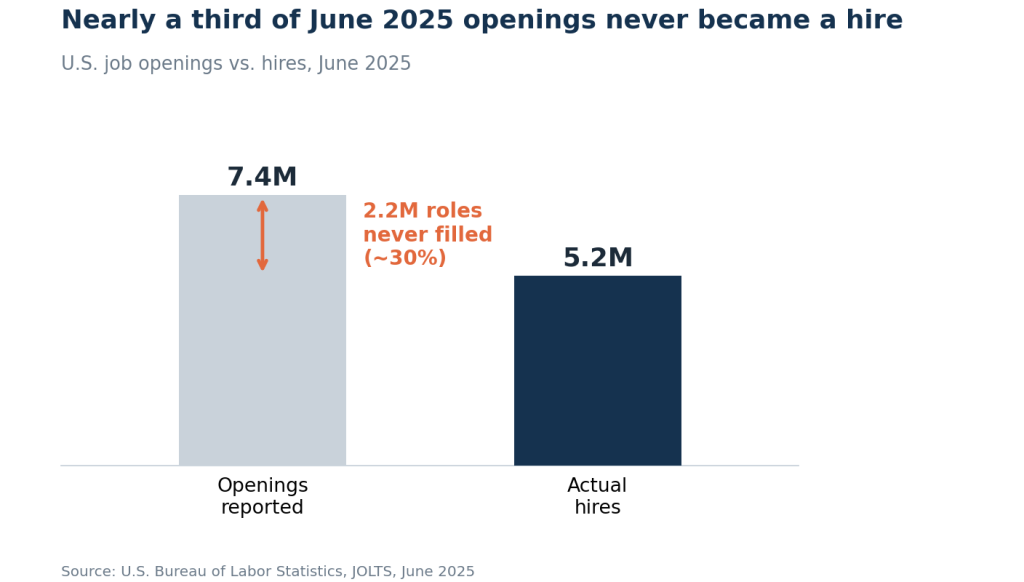
The federal data tells a parallel story. In June 2025, employers reported 7.4 million openings but made only 5.2 million hires. That gap has held between 28% and 38% every month since 2021, and Revelio Labs found hires per posting have roughly halved over five years, from about eight per ten postings in 2019 to four per ten by 2024.
Why would a real company do this? Surveys of recruiters point to a few recurring reasons, and almost none have anything to do with you: building a resume pipeline for roles not yet approved; signaling growth to investors during a freeze; satisfying a posting requirement after an internal candidate was already chosen; testing what salaries the market expects; and, bleakly, keeping current staff uneasy. A majority of hiring managers in one survey admitted posting fake roles partly to make employees feel replaceable. Eighty-one percent of recruiters in another said they’d posted ghost jobs at all.
None of this is illegal in most places, which is why it’s so common. That’s starting to change, and Canada is ahead of the curve. As of January 1, 2026, Ontario employers with 25 or more staff must state in every public posting whether it’s for an existing vacancy, the provision people call the ghost-job rule. The same legislation, from the Working for Workers Four and Five Acts, also requires a salary range, disclosure of whether AI is used to screen applicants, a ban on “Canadian experience” requirements, and notice to interviewed candidates within 45 days. For job seekers in the GTA and across Ontario, that’s a genuinely useful filter.
How to spot a ghost job before you apply
A few quick checks tell you most of what you need, usually in under two minutes:
- Check the date. The average time to fill a role was about 33 days in 2024 (SHRM). A posting up 60 or 90 days with no change probably isn’t being worked. Filter to the last one to two weeks.
- Watch for reposts. A role that vanishes and reappears with the exact same description is often a permanent pipeline listing wearing a fresh date.
- Read for specifics. A real posting names the team, the reporting line, the tools, and what the first quarter looks like. Generic language that could fit anyone is a tell.
- Look for the salary. Where a range is legally required, as in Ontario, a posting that skips it either ignores the law or wasn’t written for active hiring.
- Find it on the company’s own careers page. The single most reliable check. If it’s live on LinkedIn but missing from the company’s own site, be skeptical.
- Notice the silence. Only about a fifth to a quarter of applications on big boards get any response. Apply, follow up after a week, and if there’s nothing, not even an auto-acknowledgment, the listing is likely dormant.
A strategy that actually moves the needle
Once you filter out the noise, the rest is about being deliberate instead of spraying applications into the void. Apply to fewer roles, better: five tailored applications to recent, verified openings beat fifty generic ones. Go to the source and apply through the company’s own careers page where you can, since a company that’s genuinely hiring has a recruiter watching its own system. Reach a human, using LinkedIn to find the likely hiring manager and sending a short, professional note alongside your application, which doubles as a legitimacy test since ghost postings rarely have anyone monitoring them. Work the hidden market, because teams are often rebuilt quietly before any opening hits a board. And specialize: this market rewards a tight match, so lead with concrete, evidence-based accomplishments in your area, a regulatory submission, a tech transfer, a trial you designed, rather than broad descriptions of duties.
The path more people are quietly taking
There’s one more shift worth naming, because it changes the math on a tough search. A growing share of life sciences demand isn’t full-time headcount at all; it’s project work. With funding leaner than it was during the boom, sponsors are running smaller core teams and bringing in outside expertise for specific milestones. Fractional regulatory leads, interim heads of function, and project-based CMC and pharmacovigilance support have gone from unusual to routine, and clinical, safety, and consulting work kept posting through the downturn even as bench roles froze. The professionals doing it describe building a more resilient base of work, several clients instead of one employer, rather than waiting for a single permanent role to open.
For experienced specialists, this isn’t a consolation prize. It’s often where the real, fundable demand is, and it lets you stay in the field, keep your skills sharp, and pick work that fits your expertise.
That’s the gap Connect Research was built to close. It’s a vetted network that matches life sciences experts to biotech and pharma teams who need specific capabilities, across regulatory affairs, CMC, clinical development, translational research, toxicology, and data analysis, with contracts, payments, and admin handled so you can focus on the science. Instead of chasing
postings that may not be real, you let the right projects find you and collaborate on your own terms.
If you’re an experienced professional weighing your options in this market, it’s worth a look. You can join as a consultant and put your expertise to work where it’s genuinely wanted.
Sources: BioSpace 2026 U.S. Life Sciences Employment Outlook and Q1 2026 Job Market Report; U.S. Bureau of Labor Statistics (JOLTS, June 2025); ResumeUp.AI; ResumeBuilder.com; MyPerfectResume; Revelio Labs; Congressional Research Service (“Ghost Job Postings,” April 2025); Ontario Employment Standards Act amendments under the Working for Workers Four and Five Acts (effective January 1, 2026).
One Response
nice article