Half the field says AI-customized CVs are ATS gold. The other half says they get auto-rejected. Both are partially right, here’s the evidence.
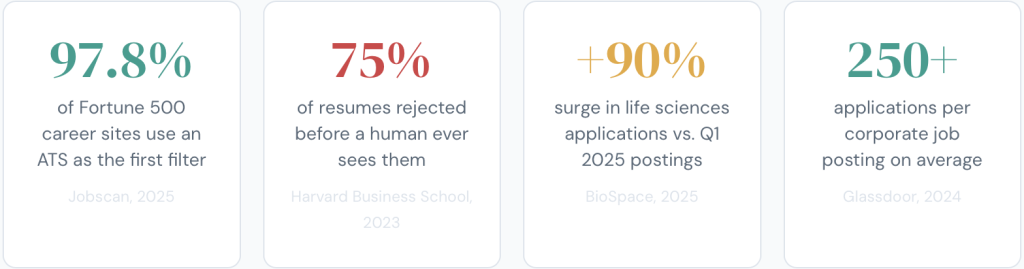
The life sciences job market has never been more competitive. Job postings dropped over 30% from their 2022 peak while applications surged 90%, yet candidates are getting contradictory advice about whether to use AI to tailor their CV. We pulled the actual data to settle it.
Before debating whether AI is appropriate, it’s worth understanding the infrastructure every application passes through. The gatekeeping is largely automated, and those systems reward specific behaviors. Understanding that architecture is what separates a strategic candidate from one who submits blind and wonders why nothing comes back.
How ATS Systems Actually Filter Resumes
An Applicant Tracking System isn’t an intelligent reader, it typically parses a resume into structured information such as skills, education, titles, and work history. Depending on the employer and software configuration, recruiters may then use screening questions, filters, keyword searches, skills matching, or automated ranking tools. Using terminology from the posting can help, but modern systems do not always depend on exact word-for-word matches.
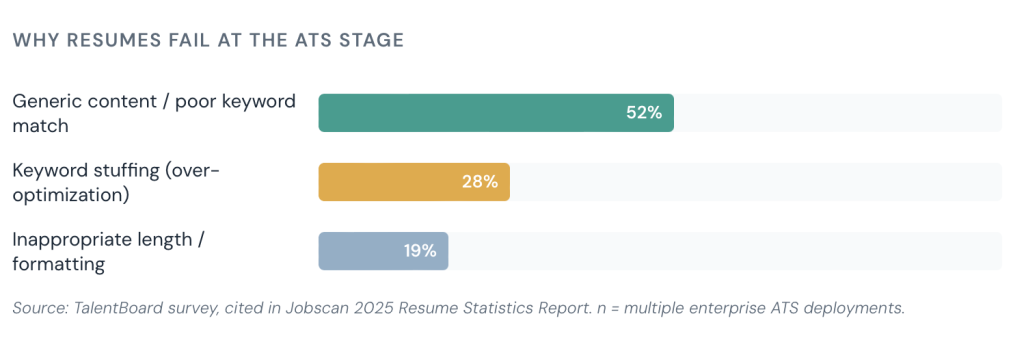
Note what the leading cause is: generic content, not AI content. The document failed to speak the language of the role. That’s the problem AI optimization can, in theory, solve, but it can also make worse if it produces generic polish instead of targeted specificity.

The Case For Using AI to Customize Your CV
There’s a controlled experiment showing it works
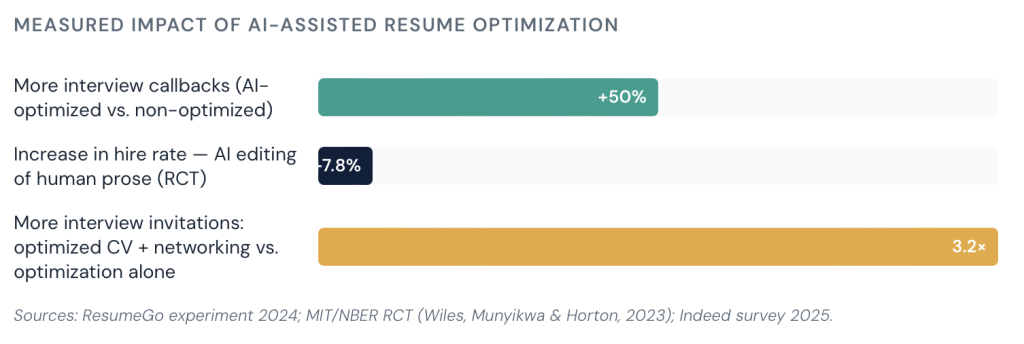
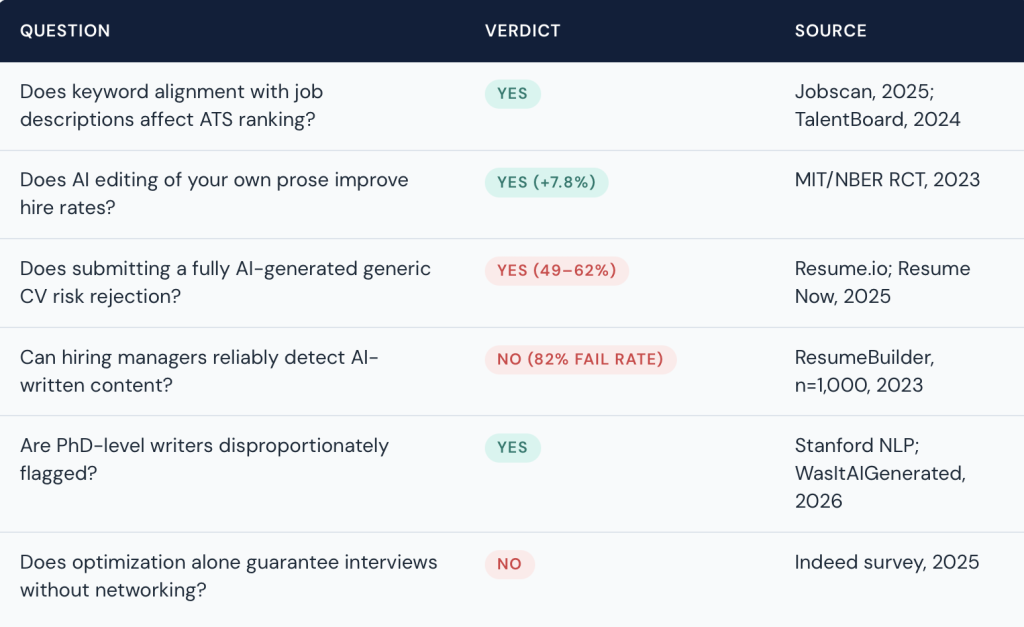
An NBER field experiment involving nearly 500,000 job seekers found that candidates offered algorithmic writing assistance were approximately 8% more likely to be hired within their first month on the platform. The intervention mainly improved resume writing quality, spelling, and grammar; it did not test ChatGPT-style generation or individualized keyword optimization. The finding therefore supports using technology to improve human-written resumes, but not every form of AI resume generation.
Recruiters can’t actually detect AI as reliably as they claim
There’s a confident LinkedIn genre of recruiter posts claiming they can spot an AI-written CV instantly. The data doesn’t support it. When hiring managers were asked to identify ChatGPT-written cover letters, only 18% got all three correct, an 82% failure rate in a controlled test. A 2025 academic study found that evaluators correctly identified AI-generated text roughly half the time, slightly above random chance. And detection accuracy fell further as AI-generated writing quality improved.
Resumes are also a uniquely difficult context for detection. Nobody writes conversationally on a CV. The baseline human document already reads like no one actually talks, which means AI writing doesn’t stand out as much as it would in, say, an email.
The application volume math makes customization necessary
High application volumes make it difficult for recruiters to review every submission in depth. Tailoring a resume therefore improves the likelihood that relevant qualifications are visible in recruiter searches, filters, and initial reviews. The argument that customization is “inauthentic” ignores the basic math: an untailored document often doesn’t reach a human at all.
The Case Against, Or at Least Against Doing It Badly
Nearly half of hiring managers auto-reject on suspicion of AI use
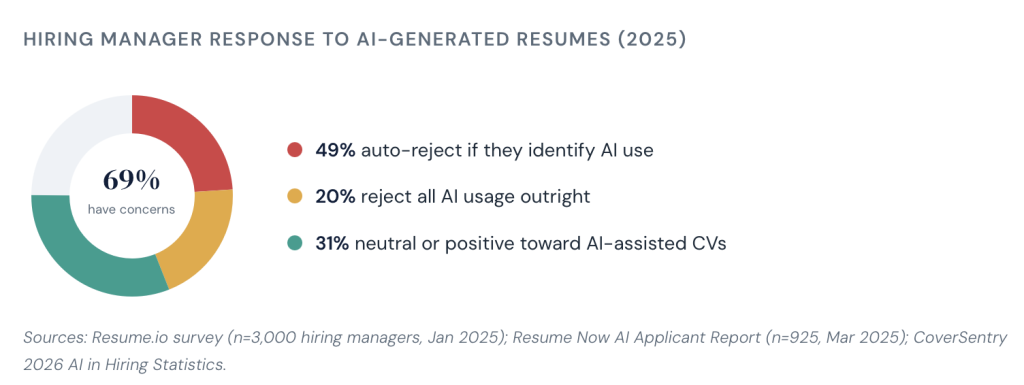
Three independent surveys from 2025 converge on a consistent finding: approximately 49% of US hiring managers say they automatically dismiss resumes they identify as AI-generated. At the extreme end, that number reaches 71% in some markets. A separate survey of 925 HR professionals found that 62% say AI-generated resumes without customization are more likely to be rejected outright.
The real target is generic output, not AI use itself
When you read the survey data carefully, the pattern is consistent: 78% of hiring managers say personalized details signal genuine interest, and rejection rates spike specifically for AI-generated content that lacks customization. The problem isn’t that AI was used, it’s that the output is vague, polished, and empty. Names of projects are absent. Role-specific achievements are generic. The document could describe anyone.

Scientific candidates are disproportionately harmed by false positives
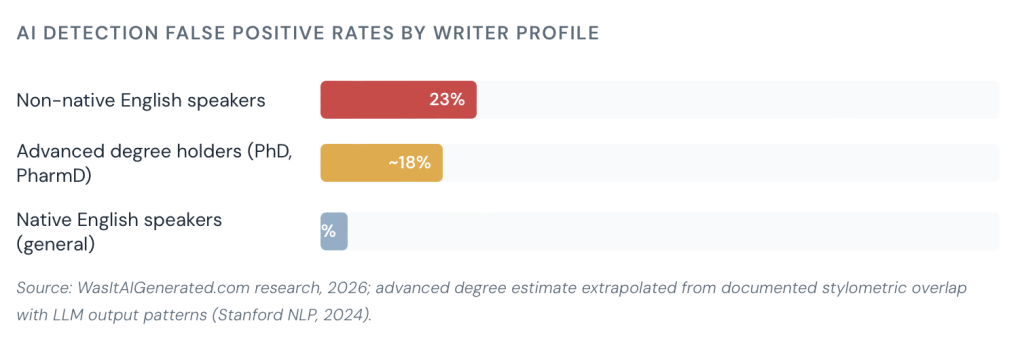
This is a structural problem that rarely gets discussed. Detection tools trained primarily on general English text have a 23% false positive rate for non-native English speakers, compared to just 4% for native speakers. More critically for life sciences: candidates with advanced degrees write in formal, structured, technical prose by training. That writing style overlaps statistically with AI output. A PhD in regulatory science who writes precisely and methodically can be flagged as AI-generated even when every word is their own.
In life sciences, the CV is only the first gate
Pharma and biotech hiring for senior scientific and regulatory roles relies heavily on human judgment and relationship. An experienced recruiter in this sector will look past standard ATS scoring to ask directly: did this person run an IND process? Do they understand CMC? Have they worked across Phase I–III? A keyword-optimized CV gets you past the filter, but the conversation that follows requires genuine depth that no amount of AI polish can manufacture.

The Evidence-Based Verdict
Both sides of the debate are arguing past each other. The real answer depends entirely on how AI is used. The data separates cleanly into two categories
What This Means Practically for Life Sciences Professionals
Use AI as an editor, not a ghostwriter. The NBER RCT result, the only controlled experiment in this space, was specifically for AI editing of human-written prose. Write your own bullets from your own experience. Then use AI to check keyword alignment with the job description, improve clarity, and ensure nothing is buried that the ATS would look for.
Mirror the exact language of the job posting. Regulatory affairs, clinical operations, pharmacovigilance, biostatistics, each subdiscipline has its own vocabulary, and hiring systems match on it literally. “GxP” and “Good Clinical Practice” are not equivalent to a keyword filter. Choose the exact term the posting uses.
Never remove specific achievements to make room for polish. The data consistently shows that 78% of recruiters are looking for specific, named contributions. Dates, compounds, indication areas, submission types, data outputs. Generic AI polish replaces the very things that make your document defensible in a human review.
Recognize the false positive risk. If you’re a non-native English speaker or hold a doctoral degree, your authentic writing may trigger AI detection tools. That’s a structural flaw in those tools, not your problem to solve by writing less precisely. The best counter-measure is specificity: names, numbers, institutions, and role-specific details that an AI could not have generated.
Treat optimization as the floor, not the ceiling. Resume optimization is only one part of a job search. Referrals, direct outreach, professional relationships, and conversations with recruiters can increase the likelihood that a qualified candidate receives human consideration.
Work with someone who has navigated this exact path
CV strategy, ATS positioning, and career transition advice lands differently when it comes from a consultant who has been through the same hiring process, or who has been on the other side of it. On Connect Research, you can post a project to connect with vetted life sciences consultants who specialize in career strategy and scientific career transitions, including professionals who have moved between academia, CROs, biotech, and pharma.