
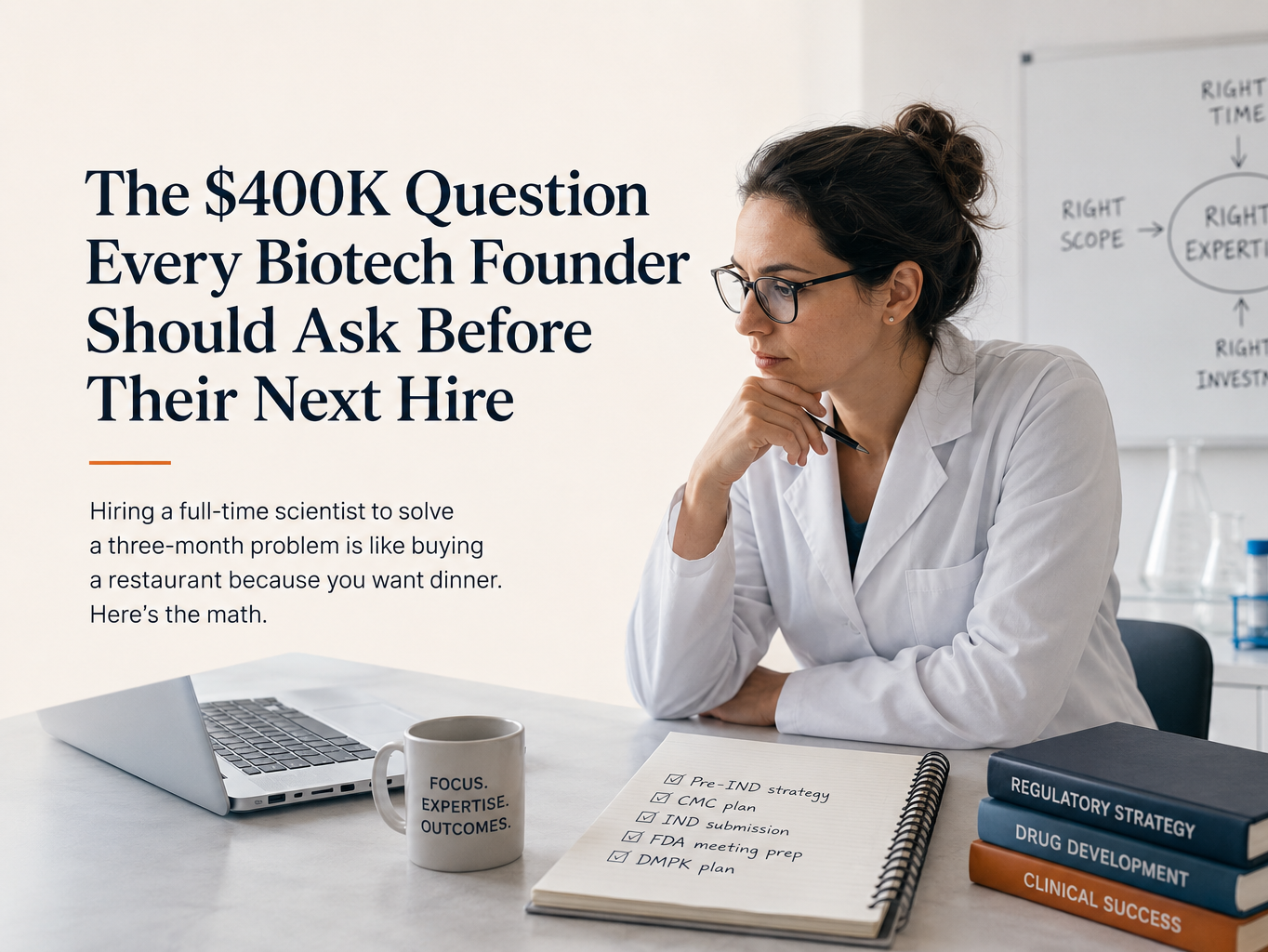
Hiring a full-time scientist to solve a three-month problem is like buying a restaurant because you want dinner. Here’s the math
There are things companies buy without really thinking about how strange the purchase is. Office coffee. Liability insurance. Enterprise software licences that nobody fully understands.
Scientific expertise belongs on that list. It is one of the oddest things a company can spend money on, partly because it is invisible, partly because its value shows up years after the purchase, and partly because the pricing makes almost no intuitive sense.
Yet in biotech and pharma, companies buy it constantly. Sometimes well. Often badly. Almost always without asking: what are we actually paying for here?
How knowledge stopped living in people
For most of human history, scientific knowledge lived in people. Entirely. If you wanted to know how a plant cured a fever, you found someone who had watched it happen many times. You paid them in food, status, or favour.
Then came universities, journals, and eventually the internet. The gap between “knowing something” and “having access to what is known” compressed dramatically. You could, in theory, read your way to expertise.
The drug industry took this seriously. Clinical trial protocols became standardised. Regulatory guidance documents became public. Statistical methodology papers piled up. The theory was that knowledge, once documented, could be transferred without the person.
That theory is, to put it charitably, incomplete
What you are actually buying when you hire a scientific consultant
When a biotech company hires a regulatory consultant who has filed forty IND applications, they are not buying the contents of those forty applications. The FDA publishes guidance. The framework is public. You could hire a very good lawyer to read all of it.
What they are buying is something harder to name. Call it calibrated judgment under uncertainty.
A skilled regulatory consultant knows which sections of a guidance document the agency weights heavily this year, not two years ago. They know which reviewer tends to fixate on manufacturing comparability data. They know that a particular sentence construction on page 12 of your briefing document will generate a question at the meeting, not because any rule says so, but because they have seen it cause that exact problem before.

That is what expertise actually is, not the formal knowledge, but the informal, accumulated, pattern-matched layer built on top of it. It is the reason two people with identical CVs can produce wildly different outcomes on the same submission.
Why most biotech companies buy scientific expertise the expensive way
Most companies respond to a scientific expertise gap by hiring for it full-time. The instinct is understandable. But for a surprising number of needs, it is the equivalent of buying a restaurant because you want dinner.
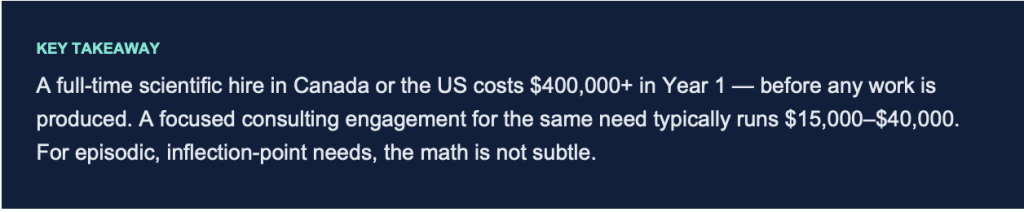
A senior regulatory scientist in Canada or the US carries $180,000–$280,000 in base compensation annually. Add recruiting fees, typically 20–25% of first-year salary, plus benefits, onboarding, and the six to twelve months it takes for someone new to become genuinely productive. You are past $400,000 before the expertise has produced anything.
A seasoned regulatory consultant engaged for a specific submission typically costs $15,000–$40,000 for the work. The expertise is identical, and in some cases more concentrated. Consultants who run multiple programs simultaneously see more edge cases, more reviewer patterns, and more failure modes than a single-company employee ever accumulates. The math is not subtle.
Why the expensive option still keeps winning
To be fair: there are real reasons the full-time hire persists. Finding the right scientific consultant is genuinely hard. The person who sounds impressive on a call and the person who will actually catch the problem in your IND are not always the same person. Vetting expertise requires expertise, a circular problem for early-stage companies that do not yet have it.
There is also a real coordination cost. A consultant needs context, briefing, and time to get up to speed on your molecule and program. If you need someone embedded in twenty conversations a week, a consulting relationship frays quickly.
And there is something less rational but equally real: the comfort of headcount. Investors ask how many people you have. Boards read org charts. “We have a full-time regulatory lead” lands differently than “we use consultants”, even when the latter reflects sharper judgment.

The inflection points where scientific consulting pays off most
Pre-IND preparation. End-of-Phase-2 meeting briefings. CMC strategy for a first NDA. DMPK characterisation before advancing a lead candidate. These are not continuous needs. They are episodic, high-stakes, and time-bounded. They are also the moments where the gap between someone who has done this forty times and someone who has done it twice shows up most clearly. The expert is not just faster, they are less likely to miss the detail that delays you by eight months.
Eight months in a biotech program is not a rounding error. At a $50,000-per-day cash burn, eight months is roughly $12 million. The economics of getting the right expertise at the right moment are not marginal.
Consultant accountability vs. employee alignment
The strongest argument for full-time hires is alignment: someone with equity and a salary has more reason to care about the outcome than someone billing by the hour.
This argument is weaker than it sounds. A consultant’s most valuable asset is their reputation. They cannot afford to be wrong repeatedly and stay employed. The career consequences of a flawed regulatory submission follow a consultant in ways they do not always follow a salaried employee, who can, in the worst case, blame the process.
What looks like misaligned incentives is often sharper accountability than the org chart provides.
None of this is an argument against hiring scientists. Biotech companies are scientific enterprises. The science needs to live somewhere permanently in the organisation. The argument is narrower: the instinct to solve every expertise gap with a full-time hire is a cognitive shortcut, not a strategy. And that shortcut is expensive in ways that rarely show up on the line item where the decision gets made.
The strange economics of scientific expertise reward the companies that can match the type of need to the type of engagement, and resist the urge to buy the restaurant every time they want dinner.
Curious whether a consultant or a full-time hire is the right call for your next milestone?
We’ve helped biotech teams navigate this exact decision. Browse vetted scientific consultants on Connect Research, or reach out and we’ll help you think it through.
Post-credits note: The “buying a restaurant because you want dinner” analogy has circulated in venture circles long enough that no one remembers who said it first. It is the clearest way we have found to describe a decision pattern that costs early-stage companies more than almost any other. We use it freely and without guilt.
Frequently asked questions
When should a biotech startup use a scientific consultant instead of hiring full-time?
- Scientific consulting makes most sense at episodic, high-stakes inflection points: pre-IND preparation, end-of-Phase-2 briefings, CMC strategy for a first NDA, and DMPK characterisation. These needs do not justify permanent headcount.
What are the hidden costs of a full-time scientific hire at an early-stage biotech?
- Beyond base salary ($180,000–$280,000), companies pay recruiting agency fees, benefits, onboarding, and absorb 6–12 months of reduced productivity. Total Year 1 cost routinely exceeds $400,000.
How does Connect Research help biotech companies find scientific consultants?
- Connect Research is a consultant-matching platform connecting biotech, pharma, and medical device companies with vetted scientific consultants across regulatory, clinical, CMC, and medical writing. Visit connectresearch.ca to learn more.
2 Responses
Interesting read on why chasing full-time scientific talent can blow a budget. The piece nails how expertise is really calibrated judgment under uncertainty—something consultants tend to excel at when you’re chasing episodic, high-stakes milestones. In Suplery we see this in action: a platform that unifies inventory, orders, and brand comms streamlines the entire pipeline, cutting onboarding chaos for beauty brands. For barbershops or salons, a real-time stocktake and a shared cart could simplify product replenishment with predictable delivery. Suplery helps you scale with a single dashboard and wholesale pricing, so you can focus on service, not admin. Curious readers: consider how a smart platform could replace fragmented processes and save you months of delays.
The cost comparison here is one most early-stage teams don’t actually run until they’re deep into a hiring decision. Project-based access to the right expertise at the right stage is exactly the kind of flexibility lean biotechs need. Thanks for laying this out so clearly.