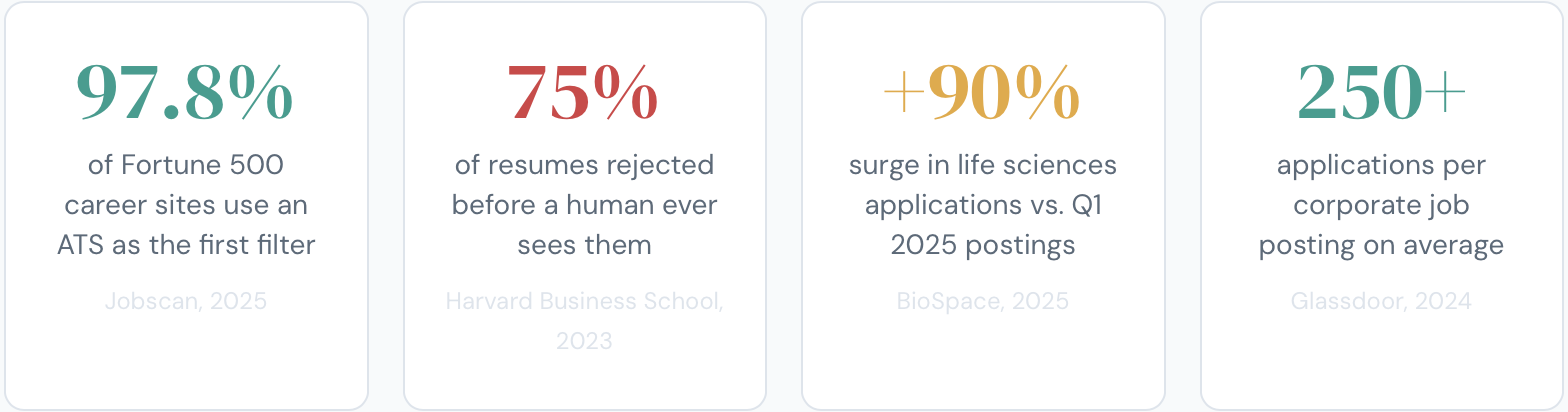
Three-quarters of clinical trial protocols now need at least one substantial amendment after they’re finalized, up from just over half a decade ago. Each one costs a median of $141,000 in Phase II and $535,000 in Phase III to implement, and adds roughly 260 days from identifying the need to final approval, per Tufts Center for the Study of Drug Development benchmarking data. Source: Tufts CSDD, New Benchmarks on Protocol Amendment Practices, as of September 2026.
Most of that risk gets built in before a single patient is enrolled, in the proposal a sponsor signs without a second read.
A CRO proposal isn’t just a price tag. It’s a set of assumptions about your patient population, your site count, your visit schedule, and what counts as a “change” worth billing for. When those assumptions are wrong, the amendment above is exactly what shows up later, at CRO change-order rates instead of the price you budgeted.
The CRO Proposal Review Checklist
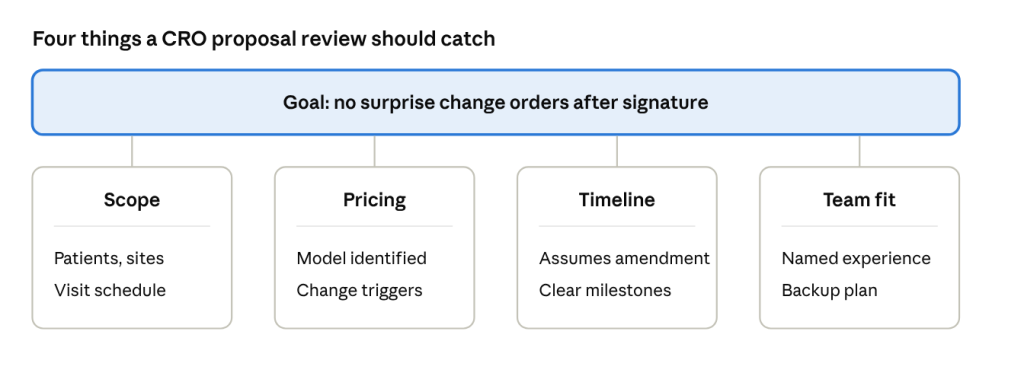
Scope and assumptions
- Patient population, inclusion/exclusion criteria, and expected screen-failure rate are stated explicitly, not implied by the price
- Site count and enrollment assumptions per site are documented, with a stated basis (prior trials, feasibility survey, benchmark data)
- Visit schedule and procedures match the protocol as currently written, not an earlier draft
- Monitoring approach (frequency, on-site vs. remote) is specified, not left as “per standard practice”
Pricing model and change orders
- Pricing model (fixed-fee, time and materials, unit-based, FSP, or a mix) is clearly identified, not just a bottom-line total
- What triggers a change order is defined in writing, not left to interpretation later
- Unit definitions (per-visit, per-patient, per-site costs) are itemized, so a scope change has a known cost, not a negotiation
- Assumptions that look unusually low relative to other proposals are flagged and asked about directly, not treated as a win
Timeline realism
- Timeline assumes at least one protocol amendment, not a best-case, nothing-goes-wrong schedule
- Milestones tied to payment are specific and verifiable, not vague (“study initiation,” without defining what that means)
- Dependencies on your own team’s deliverables (documents, approvals, drug supply) are named, so delays aren’t automatically attributed to the CRO, or hidden by it
Team and experience fit
- Named team members, not just the company’s brand, have direct experience with this modality and indication
- A backup or escalation plan exists if a named lead leaves mid-study, which happens often enough to ask about upfront
- Prior client references are for similar-sized, similar-phase studies, not the CRO’s biggest logo
- References are checked directly by phone or call, not taken only from the written proposal
Where CRO Proposals Actually Go Wrong
Most CRO cost overruns don’t come from bad-faith pricing. They come from a small number of predictable gaps.
The proposal answers the RFP, not the protocol. When an RFP is under-specified, CROs bid on their best guess of scope, and gaps surface once the actual protocol, and its eventual amendments, are locked in.
The lowest bid left something out on purpose. A bare-bones proposal at a low headline price isn’t automatically the best deal, since anything left out at proposal stage tends to reappear as a billed “extra” once the study is underway.
Change-order triggers were never defined. When a contract doesn’t spell out what counts as a scope change, every amendment becomes a negotiation instead of a known cost.
None of this means CROs are the problem. It means the proposal stage is where sponsors have the most leverage and the least visibility, and those two things rarely line up again once the study starts.
Why a Second Read Changes the Outcome
Most of the gaps above aren’t visible from inside a negotiation. Whoever is running CRO selection is also trying to close the deal and start the study, which makes it hard to also be the one stress-testing the assumptions underneath it.
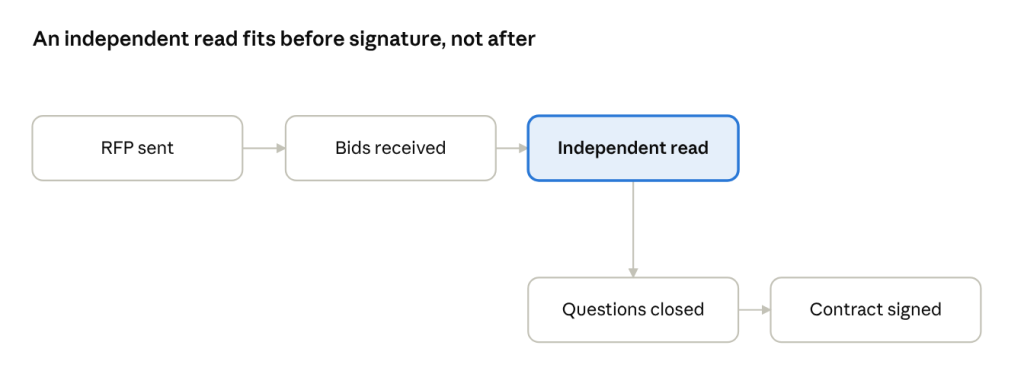
An independent review, done before signature, isn’t about second-guessing the CRO. It’s about catching a scope gap or an undefined change-order trigger while it’s still a conversation, not a change order three months into enrollment.
That’s a different question than “is this CRO any good.” It’s closer to: does this specific proposal match what your protocol actually requires.
Get a Second Read Before You Sign
If a CRO proposal is on your desk and something about the scope, the pricing model, or the timeline doesn’t quite add up, that’s usually worth a closer look before signature, not after the first invoice.
Connect Research connects biotech teams with scientists and clinical operations specialists who’ve run CRO selection from the sponsor side, for an independent read of a proposal before you sign, not a full consulting engagement you have to define from scratch.
Book a CRO Proposal Review to talk through what’s in front of you.
Frequently Asked Questions
How often do clinical trial protocols get amended after a CRO is already under contract?
Recent Tufts CSDD benchmarking data puts it at 76% of protocols needing at least one substantial amendment, up from 57% in the prior benchmarking wave, with a mean of 3.3 amendments per protocol.
What’s the difference between a fixed-fee and a time-and-materials CRO contract?
A fixed-fee contract sets the total cost upfront, with changes requiring renegotiation. A time-and-materials contract bills actual hours against agreed rates, which gives more flexibility but carries more risk of the total running past the original estimate.
What should trigger a change order in a CRO contract?
Ideally, the contract itself defines this in writing before signature: specific events like a protocol amendment, an added site, or an enrollment shortfall, rather than leaving it to be negotiated after the fact.
Is a low CRO bid a red flag?
Not automatically, but a bid that’s noticeably lower than the others is worth asking about directly. It sometimes means the CRO has excluded a service that other bids included, which tends to reappear later as a billed extra.