Talk to enough biotech teams heading into a pre-IND meeting and you’ll hear the same thing: “We had a plan. We thought we were ready.”
The gap between feeling ready and being ready is where most pre-IND meetings get harder than they need to. It’s rarely about the science itself. It’s about whether the story connecting the science to a defensible development plan holds up under questioning.
A checklist won’t replace judgment. It will surface the gaps a reviewer would otherwise find first, while there’s still time to fix them.
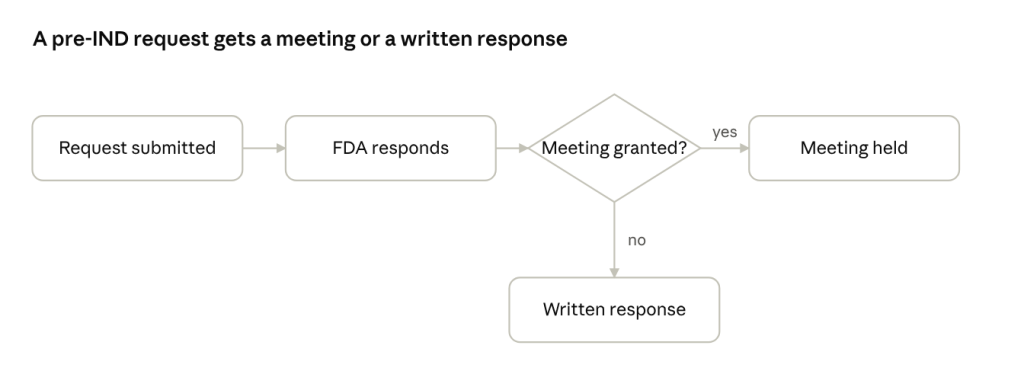
FDA must respond to a Type B (pre-IND) meeting request within 21 calendar days, and for some pre-IND requests may choose to answer in writing only, rather than holding a meeting. When a meeting is granted, FDA schedules it within 60 calendar days of the request, the briefing package is due 30 days before the meeting date, and FDA typically sends preliminary written feedback about 2 days beforehand. Source: FDA, Formal Meetings Between the FDA and Sponsors or Applicants, as of September 2026.
The Pre-IND Readiness Checklist
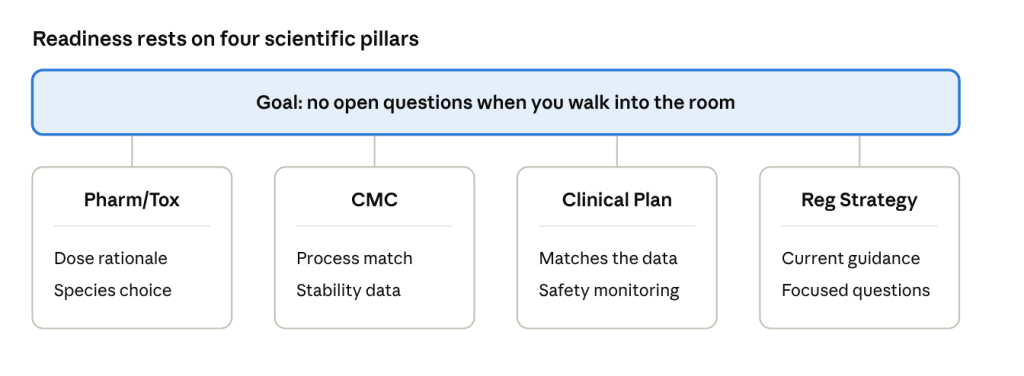
Pharmacology and toxicology
- Dose-response data supports the starting dose and dose-escalation rationale for the planned first-in-human study
- Toxicology studies use species and models relevant to the proposed mechanism; a stated rationale for the species choice is standard practice, even where it isn’t formally mandated
- Safety margins are calculated against the NOAEL and clearly stated, not implied. ICH M3(R2) treats roughly a 50-fold exposure margin as generally acceptable for a maximum tested dose, though the right margin varies by modality and risk
- Unexpected findings in nonclinical studies have a documented explanation, not just a summary table
CMC (chemistry, manufacturing, and controls)
- Manufacturing process is consistent between toxicology lots and the material planned for clinical use
- Analytical methods are validated, or a validation plan exists with realistic timing
- Stability data supports the planned clinical trial duration
- Impurity and degradation profiles are characterized, with justification for any specifications
Clinical and study design
- Proposed first-in-human study design matches the questions the nonclinical package can actually answer
- Dose-escalation stopping rules and safety monitoring plan are defined
- Patient population and eligibility criteria align with the nonclinical safety margins
- Endpoints are appropriate for the study phase, not borrowed from a later-phase protocol
Regulatory strategy
- Development plan reflects current FDA guidance for the relevant indication and modality, not guidance that’s since been updated
- Precedent programs have been reviewed, with differences from your own program clearly explained
- Questions for FDA are specific and decision-relevant, not general requests for reassurance
- Briefing package tells a coherent story end to end, not a set of disconnected sections written by different people
Common Gaps That Trigger Difficult Questions
Most rough pre-IND meetings trace back to a small number of patterns.
The dose rationale is asserted, not justified. A dose gets chosen, but the package doesn’t clearly explain why it’s safe relative to the nonclinical exposure margins. Reviewers pull on this first, because it’s usually where the reasoning is thinnest.
The nonclinical package answers a different question than the one being asked. Toxicology studies sometimes get designed around what a CRO could execute quickly rather than around what the clinical study will actually need to demonstrate.
The briefing document reads like it was assembled, not written. Sections handed off between different contributors, with no one connecting the pharmacology story to the regulatory strategy to the clinical plan, is one of the fastest ways to invite follow-up questions.
None of these are failures of science. They’re failures of narrative discipline, and they’re fixable with enough lead time.
When Outside Expertise Pays for Itself
Most of the gaps above aren’t visible from inside a program. Teams are too close to their own data to see where the reasoning has a hole, the same way a writer can’t proofread their own work.
An independent review, done early enough to matter, isn’t about staffing a role you’re missing. It’s about pressure-testing the plan before FDA does, when a fix costs a conversation instead of months of delay.
That’s a different question than “do we need a consultant.” It’s closer to: would fresh eyes on this package change what happens in the meeting room.
Get a Second Read Before the Meeting, Not After
If your pre-IND package is coming together and something about the dose rationale, the nonclinical story, or the regulatory strategy still feels thin, that instinct is usually worth listening to.
Connect Research connects biotech teams with scientists and regulatory specialists who’ve sat on the other side of these meetings, for an independent read before you walk in, not a full consulting engagement you have to define from scratch.
Book a Pre-IND Readiness Conversation to talk through where your package stands.
Frequently Asked Questions
How long does it take to get an FDA pre-IND meeting?
FDA responds to a Type B meeting request within 21 calendar days, and if a meeting is granted, holds it within 60 calendar days of the request.
What is a Written Response Only (WRO) from FDA?
For some pre-IND requests, FDA may decide a written response answers the sponsor’s questions as well as a live meeting would, and issues that instead of scheduling one.
What should be in a pre-IND briefing package?
A coherent narrative connecting the pharmacology and toxicology data, the CMC package, and the proposed clinical study design, plus specific, decision-relevant questions for FDA, submitted no later than 30 days before the meeting date.
Do I need a consultant to prepare for a pre-IND meeting?
Not necessarily. What most teams benefit from is an independent read of the package before they submit it, whether that comes from an internal reviewer, a scientific advisory board member, or an outside specialist.
Sources
- FDA, Formal Meetings Between the FDA and Sponsors or Applicants of PDUFA Products (guidance) — Type B meeting response and scheduling timelines, briefing package deadline
- FDA, M3(R2) Nonclinical Safety Studies for the Conduct of Human Clinical Trials and Marketing Authorization for Pharmaceuticals (guidance) — NOAEL-based exposure margins
As of September 2026.